
Why Offshore is Struggling With Structuring Technical Systems
Offshore wind projects depend on collaboration across multiple companies and engineering disciplines, and often several countries. However, the industry currently lacks an important element: a shared and unambiguous way of describing systems, a common language. Every supplier, EPC, OEM, and operator brings their own naming conventions and internal structuring guides. Even departments inside the same organization often tag the same system differently. This is not a minor issue, as it is one of the most common sources of error in offshore projects.
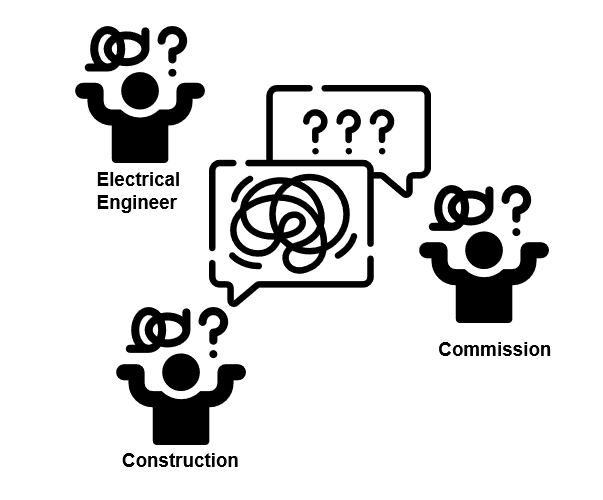
Miscommunication in large projects often leads to lost interfaces, unclear responsibilities, and missed requirements, which creates data that people cannot trust. When different stakeholders describe the same system in different ways, the operator ends up with an inconsistent setup from the start. This is a serious issue in offshore projects, where many systems, such as turbines, foundations, cables, substations, control systems, and marine operations, must work together. At the same time, digitalization has made offshore projects even more complex. Digital twins, SCADA platforms, and asset management systems all depend on clear structure and consistent naming. When suppliers deliver data with different conventions and boundaries, integration becomes difficult and increases the risk of mistakes that can affect long-term operations. All systems need to follow the same principles to keep the project coherent.
For years, different organizations have tried to establish a consistent way to structure and designate systems. The ISO/IEC 81346 series was created to provide exactly that, a common foundation for system classification and structuring. It introduced clear principles and a systematic approach that could be applied across industries. Until recently, offshore projects mainly relied on RDS‑PP, but because not all of its classification codes were based on ISO/IEC 81346, companies often created their own variations. This allowed companies to create their own codes and adapt the system to their internal habits, making the structure inconsistent from one organization to another. These limitations led to the development of ISO/IEC 81346 10:2022 (RDS-PS), which extends the 81346 framework specifically for power systems. Unlike RDS-PP, it applies the full structuring logic of ISO/IEC 81346 and provides standardized, unambiguous classification codes specifically for power systems.
By replacing vendor or company-specific naming with a common language, RDS-PS delivers the clarity and consistency that earlier attempts could not achieve. Every system and its subsystems are described using the same clear rules. RDS-PS offers three major advantages:
Standardized classification codes specific to power systems that eliminate ambiguity across stakeholders.
A lifecycle consistent structure that stays stable from early design through operations.
Machine-readable reference designations that support digital twins, SCADA systems, and modern asset management tools.
Together, these strengths make RDS‑PS a complete approach for creating clarity in complex offshore projects. This approach provides a reliable foundation for developing digital twins and long-term operational models that stay accurate, scalable, and easy to maintain as systems change over time. With RDS-PS and the use of ontologies, it will be possible to digitize all relevant documentation that will be universally understood through the ISO/IEC 81346 standard.
Offshore wind projects depend on collaboration across multiple companies and engineering disciplines, and often several countries. However, the industry currently lacks an important element: a shared and unambiguous way of describing systems, a common language. Every supplier, EPC, OEM, and operator brings their own naming conventions and internal structuring guides. Even departments inside the same organization often tag the same system differently. This is not a minor issue, as it is one of the most common sources of error in offshore wind projects.
Miscommunication leads to multiple common problems often seen in big projects, such as mismatched or lost interfaces, unclear responsibilities, and missed requirements. This results in data that cannot be trusted. When multiple stakeholders describe the same system differently, the operator inherits a system that is inconsistent from day one. Clarity is important because offshore projects do not consist of a single system. Multiple systems must be integrated: turbines, foundations, array cables, offshore substations, control and protection systems, and marine operations. When each of these is described differently by its respective supplier, the project ends with structures that do not fit together. Therefore, they all need to be described using the same principles for the project to become coherent.
Managing offshore projects is getting more complex because of the rise of digitalization in recent years. Digital twins, SCADA platforms, and asset management systems need a clear structure and consistent naming conventions to work effectively. When every supplier provides data using different naming conventions and with different boundaries, it becomes challenging to integrate everything. This can lead to mistakes that may not support successful long-term operations.
For years, different organizations have tried to establish a consistent way to name and structure systems. The ISO/IEC 81346 series was created to provide exactly that: a common, discipline-independent foundation for system classification and structuring. It introduced clear principles and a systematic approach that could be applied across industries.
Later, RDS-PP was introduced with the intention of using parts of ISO/IEC 81346 to bring more order to power system documentation. However, only some of the ISO/IEC 81346 classification rules were standardized, while others were left open for interpretation. This allowed companies to create their own codes and adapt the system to their internal habits, making the structure inconsistent from one organization to another.
Because of these limitations, a more complete solution was needed. This led to the development of ISO/IEC 81346 10:2022 (RDS PS), which extends the ISO/IEC 81346 framework specifically for power systems. Unlike RDS-PP, it applies the full structuring logic of 81346 and provides standardized, unambiguous classification codes. By replacing vendor-specific and company-specific naming with a common language, RDS PS finally delivers the clarity and consistency that earlier attempts could not achieve.
RDS PS gives digital twins a robust structural framework to rely on. The reference designations remain consistent throughout the entire lifecycle, they are machine-readable, and they follow the same logic from the early lifecycle stages through procurement, construction, commissioning, and later operation. Instead of relying on digital tools to correct inconsistencies later on, RDS‑PS shapes the data from the beginning in a way that keeps it coherent across the entire lifecycle.
A common language is the only way to ensure that systems built by different companies in different countries can operate as one. RDS PS provides that common language by removing the ambiguity that previously depended on individual interpretation and by replacing it with a clear method of classification. This gives offshore projects a dependable basis for building digital twins and long-term operational models that remain accurate, scalable, and maintainable as the system evolves.